Castle Rock Municipal Building
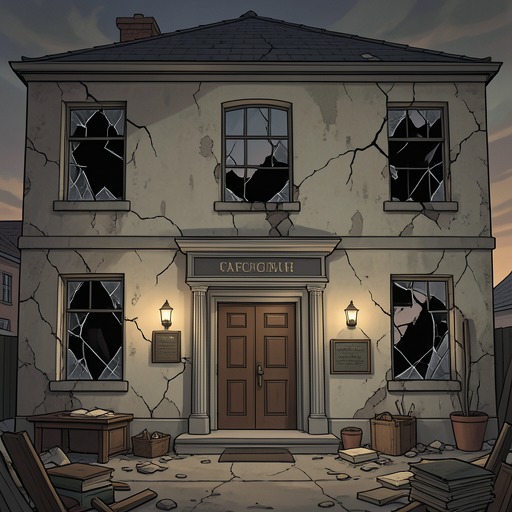
Needful ThingsThe Castle Rock Municipal Building is the town’s center of civic administration and law enforcement, bringing the sheriff’s office, the Selectmen’s Wing, and the courthouse into one consequential setting. Its ordinary functions—keeping records, handling investigations, and serving as a workplace—are progressively overwhelmed by the town’s conflicts, until an explosion turns the building into the scene of mass destruction and a symbol of civic order collapsing from within.
Civic and Law-Enforcement Center
The building’s institutional importance is established through its relationship to the sheriff’s office and local government. When Sheriff Alan Pangborn parks behind it, his station wagon stands beside Deputy Norris Ridgewick’s dilapidated Volkswagen Beetle, a modest detail that places the town’s law enforcement in a shared, practical workplace. The sheriff’s office has a side entrance opening onto the Municipal Building parking lot, while the Selectmen’s Wing and courthouse occupy other parts of the same complex. The building therefore gathers distinct public functions under one roof rather than serving only as a backdrop for police work.
The town’s local authority also operates within constraints. Leland Gaunt points out to Alan that the Castle Rock Board of Selectmen and the three County Commissioners possess approval rights over the hiring and firing of sheriff’s deputies, among other matters. The exchange makes clear that the sheriff’s office is not institutionally isolated: its staffing authority overlaps with municipal and county oversight. Separately, murder investigations fall under the Maine State Police’s Criminal Investigation Department. Local and county officers handle the vulnerable interval between discovering a crime and the state investigators’ arrival, when evidence can be mishandled and their actions may later face scrutiny. Together, these arrangements give the building a central but bounded role in public authority.
Work, Records, and Daily Use
The building remains a working administrative space even as Castle Rock’s troubles mount. Danforth Keeton makes a brief trip there to retrieve the Bureau of Taxation file, then takes it home and keeps it in a locked drawer. The correspondence concerns an impending audit of the town books; Keeton has privately used one hundred dollars from the petty-cash fund to cover a shortfall caused by his gambling losses. His secret handling of public records turns the building’s routine administrative function into part of a financial crisis that extends beyond its walls.
The sheriff’s office likewise continues its daily work amid mounting pressure. Alan reviews reports on the Cobb-Jerzyck murders, and the building’s staff and deputies respond to unfolding dangers. John LaPointe approaches the side door excited by the prospect of assisting in an arrest, having temporarily forgotten both his missing wallet and Sally Ratcliffe. The encounter instead erupts into violence: Lester Pratt throws John into the office, where he lands across Norris’s desk and scatters the paperwork. Sheila Brigham takes a shotgun from Alan’s office and returns to the bullpen, where John is in immediate danger. She strikes Hugh with the shotgun’s stock, allowing Alan and the others to leave without expecting him to shoot at them. The episode turns ordinary office furnishings and work routines into the setting and collateral of a sudden emergency.
The building also anchors Alan’s movements through town. After leaving it, he drives along Main Street and notices that a light is on in the living quarters above Needful Things. Later, as he approaches the Municipal Building, he sees Norris arriving and recognizes that he can use the deputy that afternoon. These observations show the place as both a fixed operational center and a point from which Alan monitors a community whose disturbances increasingly converge on public institutions.
A Public Institution Under Siege
As violence spreads, the building’s surroundings acquire an uncanny emptiness despite the presence of police cars and news vans. Reporters peer from the shelter of their vehicles, and a State Police officer runs toward the parking lot, but the area otherwise seems deserted. When Norris arrives shortly before the bridge is destroyed, he rushes into the sheriff’s office looking for Alan. Only Seaton Thomas and a young State Police officer remain there; they can tell him that something terrible is happening across town, but cannot direct him to the sheriff. The building is still staffed, yet the town’s emergency has outpaced its ordinary chain of response.
The courthouse steps and parking lot also become part of the same endangered civic landscape. Frank Jewett waits near the courthouse for George T. Nelson, treating the town’s screams, explosions, and gunfire as secondary to their personal quarrel. When the two men finally approach one another, their hostility briefly gives way to a tentative, conciliatory recognition. That possible reconciliation is cut short by the blast from the Municipal Building, which kills them both. The building’s destruction thus interrupts not only municipal business but also a private encounter unfolding immediately outside the institutions of law.
The Bombing and Its Aftermath
The Municipal Building is deliberately targeted by Ace Merrill and Danforth Keeton, who plant forty sticks of dynamite in two groups of twenty. One bomb is placed on the judge’s chair in the courtroom; Keeton insists that the other be put on Amanda Williams’s desk in the Selectmen’s Wing. The placement links the attack to both judicial authority and municipal government, making the building’s separate functions explicit targets rather than incidental casualties.
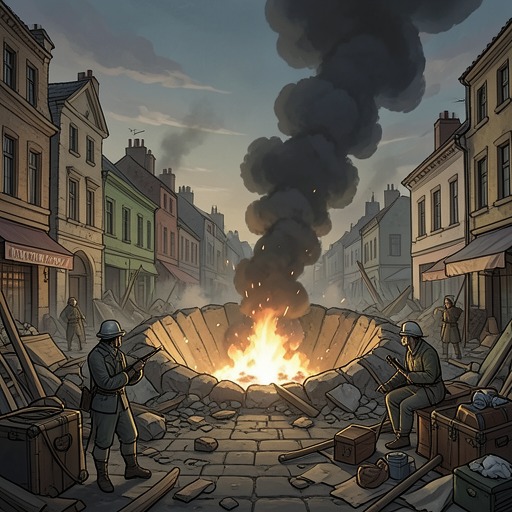
The explosion sends violet-orange light through the building’s windows before fire spreads through its openings. The slate roof lifts off and breaks apart; then the structure bursts outward, showering Lower Main Street with brick and glass. Nineteen people die, including five newspeople who had come to cover the escalating events and are killed in the disaster they were reporting. Seaton Thomas is driving the cruiser in which Norris has insisted they travel when the force of the blast lifts the car and a storm of bricks engulfs it. The impact reaches beyond the building itself, sweeping up those caught in the adjacent streets and lot.
The bombing completes the Municipal Building’s transformation from the town’s shared apparatus of administration and law enforcement into evidence of Castle Rock’s breakdown. Its records, offices, courtroom, and public authority are all contained in the structure that the attackers destroy. The loss is both material and institutional: the town’s civic center is obliterated at the moment its inhabitants most need functioning public institutions.